Who I Call When Everything Falls Apart: Rewriting Family for a Generation That Grew Up Between Worlds
When I got the worst phone call of my life — the kind that rearranges everything, before and after — the first person I called wasn't someone I share a last name with. She's a woman I met in a college dorm hallway at 19, the daughter of Haitian immigrants, raised in South Florida, who somehow became the person I call when the world stops making sense. We don't have a word for what we are to each other. "Best friend" doesn't cover it. "Chosen family" is closer, but it still feels like a phrase borrowed from a context that doesn't quite fit.
I've been thinking about that gap — the space between what the word means and what the thing actually is — for a long time. And I'm not alone in it.
The Inheritance We Didn't Ask For
There's a particular kind of loneliness that a lot of first and second-generation Americans know well, even if they don't always have language for it. It's the loneliness of being between things. Your parents' world — the one they came from, the one they carry in their bodies and their habits and their silences — is real and present and sometimes overwhelming. The American world you were raised in has its own rules, its own expectations, its own definitions of what a family is supposed to look like.
And then there's you, somewhere in the middle, building something that fits neither model perfectly.
For a lot of us, the response to that position has been to build. Not to choose one world over the other, but to construct something new out of pieces from both — and from places neither world anticipated.
"My parents have a very clear idea of what family means," says Yemi, a 29-year-old Nigerian American woman who grew up in Atlanta and now lives in Brooklyn. "It's blood, it's obligation, it's hierarchy. You take care of your people, full stop. I respect that. I was raised in it. But I also grew up here, where I watched my friends build these incredibly close networks that didn't have anything to do with who they were born to. And I wanted both. I wanted the depth of what I grew up with and the freedom of what I saw around me."
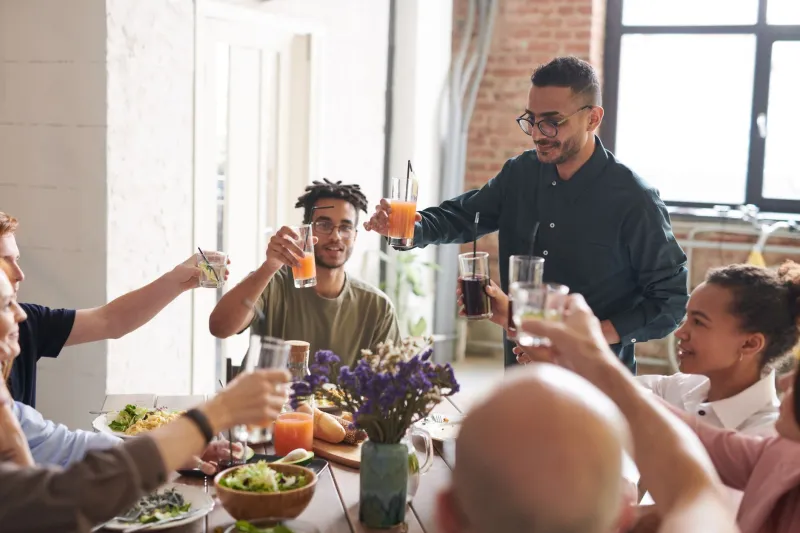
What she built looks like this: a core group of six people — two childhood friends from Atlanta, a woman she met at work, a man she met through a mutual friend's wedding, and two people from her church — who have collectively agreed, without ever having a formal conversation about it, to function as each other's primary support network. They show up for moves and breakups and job losses and medical scares. They spend holidays together when geographic or family circumstances make the traditional version impossible. They have a group chat that's been active for four years.
"I call them my people," Yemi says. "That's the best I've got."
When Traditions From Different Worlds Combine
What's striking about the chosen family structures that many first and second-generation Americans are building is how often they draw — consciously or not — on traditions from multiple cultural backgrounds at once.
The concept of chosen kinship isn't new or uniquely American. Across cultures and across history, humans have built formal and informal systems for extending family bonds beyond blood. The Filipino concept of utang na loob — a sense of deep, reciprocal obligation to those who've helped you — shows up in the way some Filipino American friend groups operate, with an unspoken understanding that showing up for each other isn't optional. West African traditions of communal child-rearing, in which children are understood to belong to and be responsible to an entire community rather than just a nuclear unit, echo in the way some African American and African diaspora friend networks organize their support systems.
When people from these backgrounds build chosen families together — which happens constantly in a country as mixed as the US — the result is something genuinely new. A kinship structure that draws on multiple traditions simultaneously, that nobody's grandparents would fully recognize, but that carries the DNA of all of them.
"My chosen family is me — Filipino — my best friend who's Black and from Louisiana, her boyfriend who's Puerto Rican, and two white friends from the Midwest who've been around long enough that they've absorbed a lot of what the rest of us brought," says Marisol, a 32-year-old in Chicago. "When something happens, we don't all respond the same way. We bring different things. And somehow that's better than if we all came from the same place. We fill in each other's gaps."
The Tension That Doesn't Go Away
It would be dishonest to write about chosen family without acknowledging the tension it creates — particularly for first and second-generation Americans whose parents come from cultures where the primacy of blood family isn't just a value but a foundational worldview.
For many people navigating this, the chosen family isn't a replacement for the family they were born into. It's a supplement — a structure that holds what the original family can't or won't. That might mean a friend group that supports a queer identity that the biological family hasn't accepted. It might mean a network of peers who understand the specific pressures of being first-generation in a way that parents, who navigated different pressures in a different time, genuinely can't.
"My parents aren't bad people. They love me. But there are things I can't bring to them," says Daniel, a 27-year-old Chinese American in San Francisco whose parents immigrated from Fujian province in the 1990s. "The gap isn't about love. It's about context. They don't have the context for some of what I'm dealing with. My friends do. My people do."
The tension, for Daniel and for a lot of people in similar positions, lives in the guilt. The feeling that building something outside the family is a kind of betrayal — a rejection of sacrifice, of everything that was given up to get you here. Many people describe working through that guilt as one of the harder emotional tasks of their adult lives.
"I had to stop thinking of it as either/or," says Yemi. "My parents' family is real. My chosen family is real. They don't cancel each other out. They're both mine."
A New Model, Still Being Built
There's no clean conclusion to this — no tidy definition of what the new American family looks like, because it looks like too many things at once. It looks like a group chat that's been going for four years. It looks like two people with a made-up handshake. It looks like a Filipino woman and a Black woman from Louisiana who show up for each other in ways that draw on traditions neither of them could fully name.
What it shares, across all its variations, is intentionality. These aren't families people fell into. They're families people chose, built, and keep choosing every time something hard happens and they pick up the phone.
That might be the most American thing about it — and also the most universal. The decision to show up for someone who isn't required to show up for you. The decision to call them family anyway.