We Made It Up — And It's the Most Real Thing We Do All Year
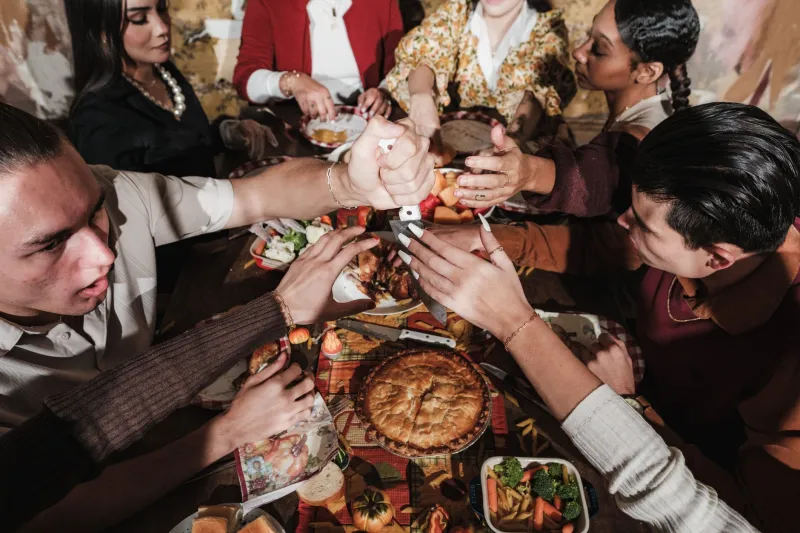
There's a table in Marisol Reyes-Kim's Chicago apartment that shouldn't work. On one end: a platter of her Korean mother-in-law's japchae, glistening with sesame oil. On the other: a stack of her grandmother's tamales, still wrapped in corn husks. In the middle: a store-bought pumpkin pie because, honestly, nobody wanted to fight about that one.
This is what November looks like in her household. Not Thanksgiving. Not Chuseok. Something they've started calling "Harvest Table" — a made-up holiday that's been running for four years now and has somehow become the thing everyone plans their travel schedule around.
"The first time we did it, we kind of laughed about how weird it was," Marisol told us. "Now my sister-in-law flies in from Seattle for it. My cousin drives up from Indianapolis. It's real. It became real."
The Problem With Picking a Side
For a long time, the dominant narrative around multicultural families during the holidays went something like this: you celebrate one tradition in full, you dabble in the other, and you call it a day. Maybe you hang a Star of David next to a Christmas tree. Maybe you eat mooncakes before the Thanksgiving turkey. The cultures coexist, but they don't exactly talk to each other.
What's shifting now — especially among Gen Z and younger millennials — is the impulse to stop treating traditions like competing teams and start treating them like ingredients. You're not picking a winner. You're cooking something new.
Jordan Osei, 28, grew up in Atlanta with a Ghanaian father and a white American mother from rural Tennessee. For most of his childhood, Christmas meant two separate celebrations: one at his dad's family's house, full of jollof rice and highlife music, and one at his mom's, with a ham and a football game in the background. He loved both. He also always felt slightly split.
"I spent years feeling like I had to code-switch my holidays the same way I code-switched everything else," he said. "At some point I just thought — why am I doing this to myself?"
So three years ago, Jordan and his partner started hosting what they call "The Convergence" on December 26th — the day after Christmas, when everyone's already in town but nothing is scheduled. Guests are asked to bring one food item that means something to their family. The rule is you have to explain it. No silent dishes. Every plate comes with a story.
When the Ritual Becomes the Point
What makes these invented celebrations stick isn't just the novelty. It's the intentionality. When you don't inherit a tradition wholesale, you have to actually decide what goes into it — which means you have to know why.
That process, it turns out, teaches people things about their own families they never thought to ask.
Nadia Volkov, 31, is the daughter of Ukrainian immigrants who came to the US in the late 1990s. She married into a Puerto Rican family five years ago and has spent the time since trying to figure out where her traditions end and her in-laws' begin. Last year, she and her mother-in-law created a New Year's celebration that pulls from both cultures — a Ukrainian-style toast ritual combined with the Puerto Rican tradition of parrandas, where friends and family show up unannounced with instruments and food.
"My mom cried the first time we did it," Nadia said. "Not because it was sad. Because she saw her traditions being taken seriously by people who had no obligation to care about them."
That emotional weight is something researchers who study cultural identity have been paying attention to. When a tradition is chosen rather than inherited, it carries a different kind of meaning — one that's been earned rather than assumed.
Not Erasure. Expansion.
Some people push back on this. Elders in particular sometimes read hybrid celebrations as a dilution — a sign that younger generations aren't committed enough to do things the right way. It's a fair concern, and the people building these new rituals are often the first to acknowledge it.
Marisol is careful to make sure the japchae is made from her mother-in-law's actual recipe, not a shortcut version. Jordan consults his dad about which Ghanaian elements to include and which ones shouldn't be removed from their original context. Nadia's parranda still follows the traditional structure — the improvisation is in the combination, not in the execution.
"We're not watering anything down," Jordan said. "If anything, we're making people pay more attention to each tradition because it's sitting next to something unfamiliar. You actually have to explain it. You actually have to know it."
That's the thing about invented holidays: they demand participation. You can't just show up and go through the motions of something you've done a hundred times. You have to be present, curious, a little bit willing to look confused.
What This Looks Like Going Forward
None of these families think their hybrid celebrations are going to replace anything. Marisol still goes to her grandmother's house for a traditional Christmas Eve. Jordan still calls his dad at midnight on New Year's. Nadia still makes her mom's borscht every January 7th for Orthodox Christmas.
But the invented days — the ones nobody handed them — have taken on a weight that surprises even their creators.
"It's ours," Marisol said simply. "My kids are going to grow up thinking Harvest Table is a real holiday. And maybe it will be, for them. Maybe that's how all holidays start."
She's probably not wrong. Every tradition someone follows today was invented by someone, somewhere, for reasons that made sense to them at the time. The remix generation is just doing it faster, more consciously, and with a lot more dishes on the table.
And honestly? That sounds like America to us.