You Might Already Be a Global Citizen — You Just Haven't Noticed
Let me describe someone I know.
She lives in a mid-sized college town in Ohio. She shops at a grocery store where the woman at the deli counter is from Ethiopia and the guy stocking produce moved here from Guatemala six years ago. She gets her nails done by a Vietnamese American technician whose parents came over in the 1980s. She eats at a Thai restaurant so often that the owner knows her order. She follows a Pakistani Canadian comedian on Twitter, a Japanese American ceramicist on Instagram, and gets most of her news through a newsletter written by a first-generation Haitian American journalist based in Miami.
She describes herself as "not really a world traveler." She's never had a passport.
This is not a knock on her. This is the point.
The Border Came to You
There's a persistent idea in American culture that international experience is something you acquire by going somewhere — by getting on a plane, eating street food in Bangkok, getting lost in Lisbon. And sure, travel does things to a person. But it's not the only mechanism of cultural exchange, and for a lot of Americans, it's not even the primary one.
The United States is home to more than 45 million immigrants, and that number doesn't account for the tens of millions of second- and third-generation Americans who maintain active cultural ties to their families' countries of origin. These people are your coworkers, your classmates, your neighbors, your favorite content creators. They are, quietly and constantly, expanding your frame of reference — if you're paying attention.
The question I keep coming back to is: are we?
What a "Local" Life Actually Looks Like Now
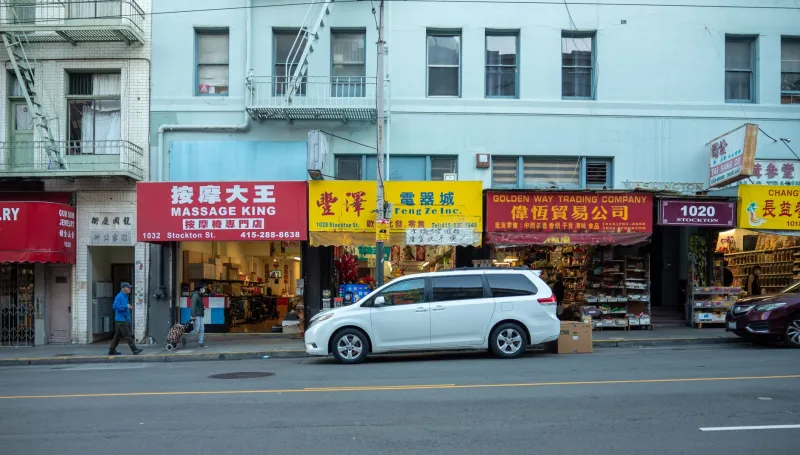
I moved to a neighborhood in Los Angeles about three years ago. My block has a Salvadoran bakery, a Korean-Mexican fusion taco spot, a Cambodian-owned nail salon, and a corner market run by a Yemeni family that stocks both American snack food and a surprisingly excellent selection of imported dates. None of this is unusual for LA, but I want to be clear: I'm not in some hyper-curated multicultural enclave. This is just a regular block.
For the first few months, I treated all of it as backdrop. The bakery was where I grabbed coffee. The taco spot was convenient. The corner market had good hours. I was present without being aware.
It took a conversation — a real one, not a transaction — with the woman who runs the bakery to shift something in me. She mentioned offhandedly that one of the pastries I'd been ordering for months was made from a recipe her grandmother brought from El Salvador, and that she'd had to modify it because the specific masa her grandmother used wasn't available here. She'd spent two years finding a substitute that felt right.
I had been eating two years of someone's quiet research and hadn't known it. That felt like something worth sitting with.
The Digital Cross-Cultural Bubble
Online, the geography gets even blurrier. Social media algorithms are often criticized — fairly — for creating echo chambers. But they also do something else: they surface voices from across the world based on interest rather than location. If you've ever fallen down a rabbit hole of Japanese woodworking videos, or found yourself genuinely invested in a British-Nigerian comedian's family vlogs, or spent an afternoon reading essays by a writer based in the Philippines about growing up between two cultures — you've been participating in cultural exchange. You just probably didn't call it that.
This matters because the way we label experiences affects how we value them. "Scrolling" sounds passive. "Cultural exchange" sounds like something that happens at a diplomatic summit. But the gap between those two things is narrower than we think, especially for younger Americans who are building their worldviews substantially online.
Gen Z, in particular, seems to understand this intuitively. Many of them report feeling closer to online communities built around shared interests — communities that are inherently international — than to geographic communities built around proximity. That's not rootlessness. That's a different kind of root system.
The Comfort of Not Noticing
Here's the harder part of this conversation: there's a reason a lot of us don't register the cross-cultural texture of our daily lives. Noticing requires acknowledgment, and acknowledgment comes with a certain responsibility.
If you recognize that your food, your music, your humor, your language, your sense of what's cool or funny or moving has been shaped by people from other parts of the world — people who are often doing this shaping under conditions of real difficulty, navigating immigration systems and language barriers and economic precarity — then you have to grapple with what that means. You have to ask whether you're a passive beneficiary or an active participant. You have to think about whether the exchange is mutual.
That's uncomfortable. It's easier to just enjoy the taco.
But I think the discomfort is worth it. Because on the other side of that reckoning is something genuinely good: the recognition that you are already connected to a much wider world than your zip code suggests. That your identity has been shaped by crossings and exchanges you didn't choose and maybe didn't notice. That you are, in ways both small and significant, already a citizen of something larger than your own particular corner.
The Invitation
You don't have to book a flight to start thinking of yourself differently. You can start by having an actual conversation with the person at the counter instead of just completing the transaction. You can start by asking where a dish comes from instead of just eating it. You can start by following the thread of an unfamiliar cultural reference instead of scrolling past it.
Sulasok exists because stories cross borders in all kinds of ways — not just through passports and plane tickets, but through kitchens and comment sections and conversations between neighbors who came from completely different worlds and ended up on the same block.
You're already part of this. You might as well show up for it.