Grandma's Kitchen Is the Real Culinary Frontier
There's a version of the American food story that gets told a lot. A chef discovers a foreign ingredient, puts it on a tasting menu, gets a write-up in a glossy magazine, and suddenly a cuisine "arrives" in America. It's a tidy narrative. It's also incomplete.
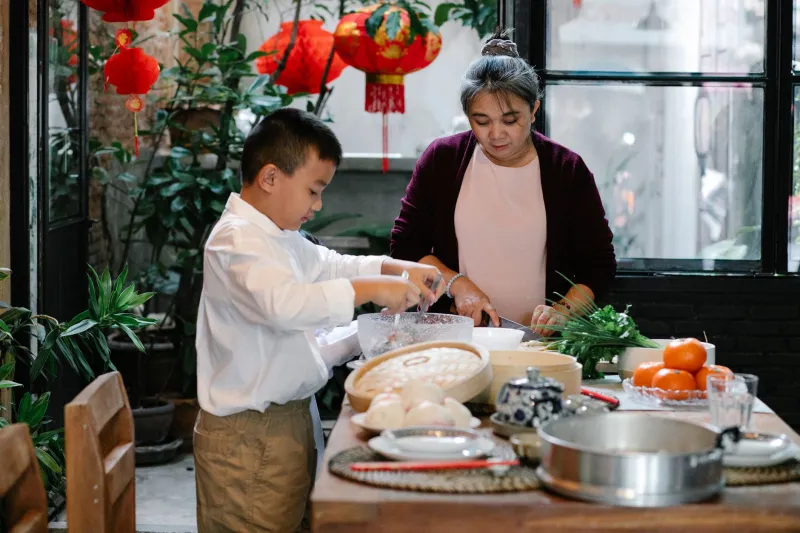
Because the real story — the messier, warmer, more honest one — starts somewhere else entirely. It starts in apartment kitchens in Queens, in church fellowship halls in Houston, in suburban homes in the San Gabriel Valley where a grandmother is making something her own grandmother taught her, adjusting it slightly because the right chili paste isn't available at the local grocery store, and the closest thing is sitting next to the sriracha on the bottom shelf.
That improvisation? That's American food culture in real time.
The Kitchen Before the Restaurant
When food historians talk about how cuisines travel, they tend to follow the restaurant trail. Italian food "came to America" through trattorias in Little Italy. Chinese food spread through Cantonese-run diners during the railroad era. But restaurants are the public face of a much more private process. The real transmission happens at home — through potlucks, through holiday tables, through the slow education of a neighbor who keeps getting invited over and eventually starts asking for the recipe.
Maya Reyes, a 28-year-old based in Chicago, grew up watching her Salvadoran mother make pupusas every Sunday. Not as a cultural statement. Just as Sunday food. "It wasn't until I brought a friend from college home for the weekend that I realized this wasn't something everyone grew up with," she says. "She lost her mind over them. She started texting me asking how to make the curtido. That's when I realized — oh, my mom's been teaching people this whole time. She just didn't know it."
Maya's mother, Carmen, never opened a restaurant. She never appeared on a cooking show. But through her daughter's friends, her church community, and eventually a small but devoted Instagram following Maya created on her behalf, Carmen's recipes have reached people across three states.
The Viral Home Cook Is a Different Animal
Social media has changed something fundamental about how home cooking crosses borders. Platforms like TikTok and YouTube have created space for cooks who never went to culinary school and never wanted to — people who cook the way they were taught, with the specific techniques and flavor logic of their family's country of origin.
These aren't influencers performing authenticity. They're people who happen to have a phone and something genuinely worth sharing.
Jun Park, a second-generation Korean American in Los Angeles, started posting his attempts to recreate his late father's doenjang jjigae — a fermented soybean paste stew — during the early pandemic. He was explicit about his uncertainty. "I didn't really know what I was doing," he admits. "I was calling my aunts in Seoul, trying to reverse-engineer something from taste memory." His videos documenting that process, complete with failed batches and long phone calls conducted half in Korean, half in English, accumulated hundreds of thousands of views. More importantly, they sparked comments from other second-generation Koreans doing the exact same thing — and from non-Korean Americans who had never heard of doenjang and suddenly wanted to try it.
"Someone in Nebraska told me they drove 45 minutes to find the paste at a Korean grocery store," Jun says. "That still gets me."
Fusion That Didn't Ask Permission
Here's something that often gets lost in conversations about food and cultural authenticity: the most interesting culinary evolution doesn't happen in restaurant test kitchens. It happens when a Filipino American mom in New Jersey realizes she can use the adobo braising technique on chicken wings for the Super Bowl. It happens when a Nigerian grandmother in Atlanta starts incorporating collard greens into her egusi soup because they're cheaper and more available than the bitter leaf she'd use back home, and finds that her grandkids actually prefer it.
This is fusion — real fusion, not the kind that gets a clever name on a food truck chalkboard. It's practical, it's personal, and it carries the weight of actual lived experience.
Sofia Nguyen, whose mother immigrated from Vietnam to Texas in the early 1990s, describes her family's cooking as "Vietnamese with a Southern accent." Her mother learned to make biscuits from a neighbor. She started serving them alongside pho on cold mornings. "It sounds weird until you try it," Sofia laughs. "Then it sounds obvious."
What We're Actually Eating When We Eat "American"
The uncomfortable truth is that American cuisine — whatever that means — has always been a living document written by people who weren't born here. The tomato, now central to Italian-American cooking, came from the Americas. Chili, as Americans know it, is a borderlands invention. The hot dog has German roots. Mac and cheese, in its current form, owes a significant debt to James Hemings, an enslaved Black man who trained as a chef in France and brought the technique back to Thomas Jefferson's household.
Food doesn't respect the lines we draw. And immigrant home cooks — the ones making Sunday dinner, the ones posting videos from their actual kitchens with actual family chaos in the background — are continuing that tradition whether the food media establishment acknowledges it or not.
Carmen Reyes doesn't have a Michelin star. She doesn't have a cookbook deal, though Maya is working on changing that. What she has is a recipe for curtido that now lives in the phones of roughly 40,000 people who found her through her daughter's posts. Some of them are Salvadoran. Most of them aren't.
All of them are cooking something that crossed a border to reach them — and making it, slowly, their own.