The Places Between the Places: Where America's Next Subcultures Are Actually Growing
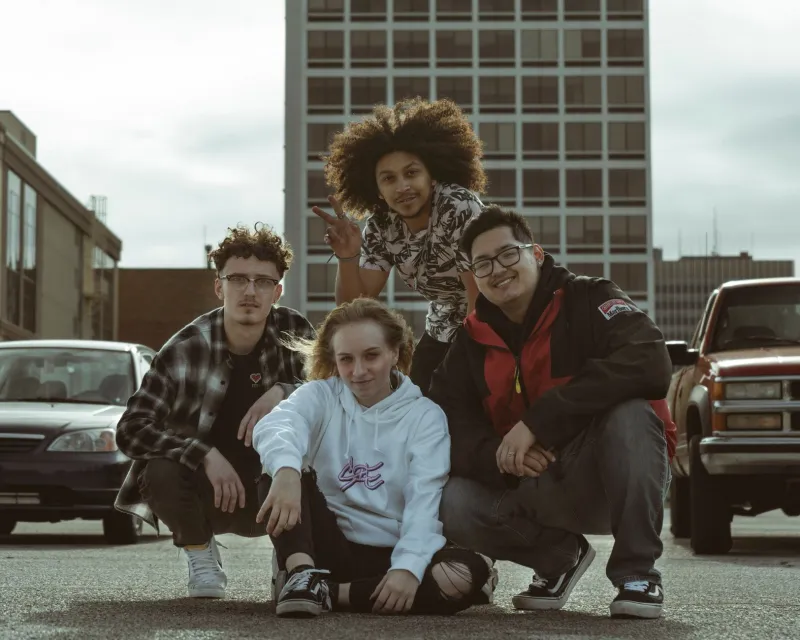
There's a strip mall in Fremont, California, that doesn't look like much from the outside. A boba shop, a South Asian grocery, a nail salon, a halal fried chicken spot that's inexplicably also a sneaker resale store. On weekend evenings, the parking lot fills up with teenagers who have nowhere in particular to be and no particular reason to be there together except that this is, somehow, their spot.
They're Afghan-American and Indian-American and Mexican-American and just plain American in ways that don't fit neatly into any of those categories. They listen to a playlist that makes no algorithmic sense — Punjabi MC into Tyler, the Creator into a corrido tumbado into a hyperpop track with Tagalog ad-libs. They dress in a way that would confuse any trend forecaster trying to pin down a single reference point.
This is not a scene that has been written about in the New York Times Style section. Nobody has made a documentary about it. And that's kind of the whole point.
The Coastal Bias in How We Talk About Culture
American cultural journalism has a geography problem. The default assumption — built into decades of trend pieces, music reviews, and arts coverage — is that culture radiates outward from a handful of coastal cities. New York creates it. LA amplifies it. Everyone else receives it.
This was always a simplification. It's becoming increasingly false.
The conditions that actually generate new subcultures — density, diversity, boredom, a slight sense of being overlooked, access to digital tools, and enough local specificity to give a scene its own flavor — exist in abundance in places that cultural media routinely ignores. Columbus, Ohio. Lowell, Massachusetts. Dearborn, Michigan. Gwinnett County, Georgia. The Inland Empire. The outer-ring suburbs of Houston.
These are places where immigrant communities have been putting down roots for decades, where their American-born kids are now teenagers and young adults with one foot in their parents' world and one foot in the broader American cultural landscape — and where something genuinely new is being made in the friction between those two things.
Dearborn Doesn't Need Your Validation
Dearborn, Michigan, has the largest Arab-American population of any city in the United States. It's also, by most standard cultural metrics, a mid-sized Midwestern city with a struggling downtown and a lot of strip malls.
What it has produced, quietly and without much national fanfare, is a distinct youth culture that blends Arab musical traditions with Detroit's deep hip-hop and electronic music heritage, filtered through a specifically Midwestern sensibility that's hard to describe but instantly recognizable once you've encountered it.
Artists like Ramadan Fest (a collective more than a band) have built local followings by making music that is completely untranslatable to someone who doesn't understand the specific texture of growing up Arab-American in Michigan. The references are hyperlocal. The humor is dry. The production pulls from dabke rhythms and Detroit techno with equal fluency.
Ask anyone involved whether they're trying to make it in New York or LA, and the answer is usually some version of: why would we leave? Everything we're making is about here.
The Suburb as Creative Incubator
Suburbs get a bad reputation in cultural conversations — associated with conformity, sprawl, and the absence of anything interesting. But for the children of immigrants, suburbs often tell a different story.
The suburbs were where immigrant families went when they could afford to leave the city — when they'd saved enough, established enough, built enough of a foundation. That means suburban immigrant communities often have a stability and density that inner-city communities don't always have. There are established temples, mosques, churches, cultural associations, and grocery stores. There are aunties who know everyone and uncles who have opinions about everything.
For kids growing up in these environments, the suburb isn't a cultural void. It's a pressure cooker. You have your parents' world, which is rich and specific and demanding. You have American pop culture, which is everywhere and inescapable. You have the physical reality of your town, which probably has a Chipotle and a Walmart and not much else. And you have the internet, which connects you to every subculture that has ever existed anywhere.
What happens when you put all of that together in a teenager with time on their hands and something to say?
You get something new.
Gwinnett County and the Invention of Something With No Name Yet
Gwinnett County, in suburban Atlanta, is one of the most ethnically diverse counties in the American South. It's home to large Korean, Indian, Latinx, Vietnamese, and African communities, all overlapping in a landscape of office parks, megachurches, and international grocery stores.
The youth culture that's emerged there over the past decade defies easy categorization. Local high school kids describe a style that pulls from Korean streetwear, Atlanta trap aesthetics, and South Asian festival fashion — sometimes all in the same outfit. The music scene is similarly hybrid, with producers fluent in K-pop production techniques making beats for rappers whose lyrics switch between English and Spanish mid-verse.
None of this has a name yet. That's not a problem. Names come later, usually applied by outsiders trying to package something for consumption. The people inside the thing don't need to name it. They just live it.
Why the Internet Isn't Enough — Place Still Matters
It would be easy to say that geography doesn't matter anymore — that subcultures are just online communities now, untethered from physical place. And there's truth in that. Discord servers and TikTok sounds do create real cultural communities across vast distances.
But the most interesting subcultures still seem to have a physical anchor. A parking lot. A community center. A specific stretch of road where everyone ends up on Friday nights. Place creates the friction and the specificity that purely online communities often lack. It forces you to actually be around people who are different from you in ways you didn't choose, and to make something out of that.
The strip mall in Fremont is not an accident. It's a meeting point. And meeting points are where culture has always been made — not in the places with the best PR, but in the places where people actually show up.
The next time someone tells you that all the interesting stuff is happening in New York, ask them when they last spent a Friday night in a suburban parking lot in Gwinnett County. The answer, almost certainly, is never.
That's their loss.